Your primary type
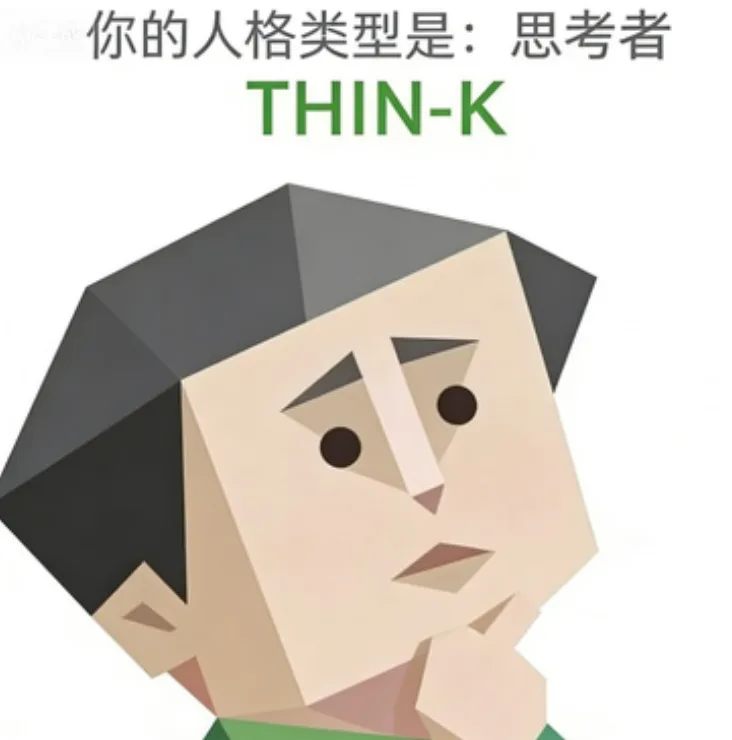
THIN-K
The Overthinker
Deep thinking for 100 seconds.
Scientists have determined that the Overthinker's brain is wired fundamentally differently from a normal brain, which is why this type makes up only 0.00001% of the population. As the name suggests, your brain is always, always running. You evaluate information ruthlessly. You care about premises, evidence, logical chain of reasoning, potential bias — and in a pinch, a full background check on the author's ideological history going back three generations. In this age of infinite information, you are nobody's follower. You weigh the pros and cons of every relationship. You fiercely guard your own mental space. When people see you zoning out alone, they assume you are spacing. Fools. That is not spacing. That is your brain sorting, filing, and incinerating every piece of information you have absorbed today. You are like a rigorous academic, observing this chaotic world with a cool eye, and then, with perfect elegance, drawing the curtains of your private study and muttering to yourself: 'Huh. I came into this quiz expecting to be dragged, and it turns out I got a totally normal result?' The author says: being 'normal' inside a pile of 'not normal' results is, in fact, deeply abnormal.
Your 15-dimension scorecard
Self Model
You mostly know what you are about, and a random stranger cannot talk you out of it.
You have a clear read on your temper, your wants, and where your hard limits are.
Comfort and safety come first. You see no reason to run life in sprint mode every single day.
Emotion & Attachment Model
You tend to trust the relationship itself. A little turbulence does not send you into a tailspin.
You invest, but you keep an exit ramp. You will not shove all your chips to the middle.
Personal space matters a lot. No matter how in love you are, you need a corner that is yours alone.
Attitude Model
Not naive, not a full-blown conspiracy theorist. Your default move is to wait and see.
If a rule can be side-stepped, you will side-step it. Comfort and freedom come first.
You do things with direction. You roughly know which way you are pointed.
Action Drive Model
Sometimes you want to win, sometimes you just want to avoid hassle. Your motives are mixed.
You call it quickly. Once you have decided, you do not love revisiting.
You can deliver, but your state depends on the day. Sometimes locked in, sometimes lying down.
Social Model
You are a slow boot in social situations. Making the first move usually costs you a long charge-up.
You run strong boundaries. Get too close and you will instinctively take half a step back.
You switch versions of yourself fluently across contexts. Authenticity is released in layers.